BlackRock is investing approximately $26 billion (38 trillion KRW) into the South Korean stock market by 2026, driven by the market's undervalued potential, improving corporate earnings, and long-term growth prospects. The significantly lower Price-to-Book Ratio (PBR) compared to global averages makes Korean stocks an attractive opportunity for long-term investors like BlackRock.
Why Is BlackRock Focusing on Korean Stocks in 2026?
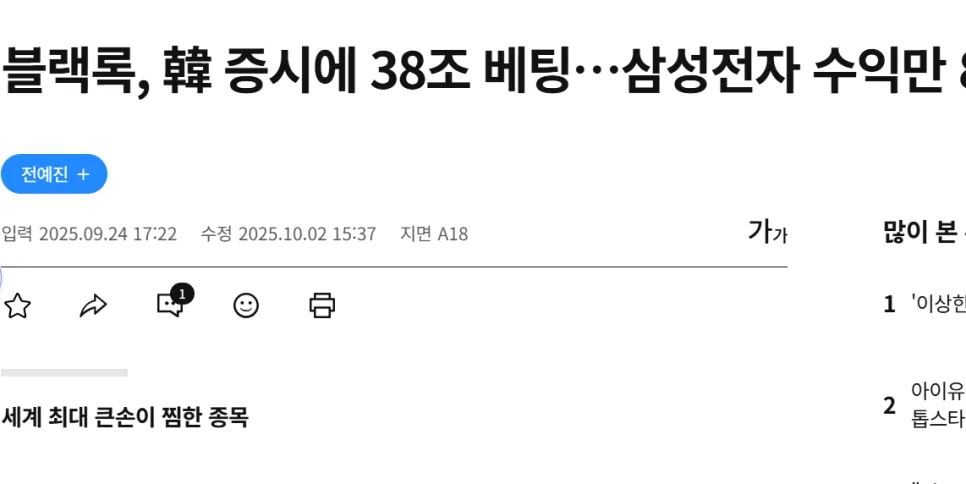
As the world's largest asset manager, BlackRock oversees a staggering $13.9 trillion (approximately 19 quadrillion KRW) in assets as of Q1 2026. This colossal sum dwarfs South Korea's national budget by over 40 times. BlackRock's substantial investment of around $26 billion (38 trillion KRW) in Korean stocks is influenced by a confluence of factors. The firm holds significant stakes in major Korean corporations such as Samsung Electronics, KB Financial Group, Naver, and Shinhan Financial Group. Recently, BlackRock expanded its portfolio by acquiring shares in Samsung Heavy Industries, further signaling its confidence in the Korean market. The value of BlackRock's Samsung Electronics holdings alone exceeds $17 billion (25 trillion KRW), significantly surpassing the personal stake of Chairman Lee Jae-yong. This large-scale investment underscores the growing appeal of the Korean market to global investors.
What Makes Korean Stocks Attractive? (Undervaluation and Growth Potential)
The primary allure of the Korean stock market for BlackRock is its 'undervaluation.' As of 2026, the KOSPI's Price-to-Book Ratio (PBR) hovers around 1.4x, less than half the global average PBR of 3.1x. This indicates that Korean stocks are trading at a significant discount compared to other markets with similar profitability, presenting a compelling buying opportunity for long-term investors. Furthermore, corporate earnings are showing robust improvement, with Samsung Electronics projected to increase its operating profit by 33% year-over-year in 2025. KB Securities forecasts a remarkable 165% year-over-year increase in the KOSPI's total operating profit for 2026. This earnings growth is not confined to the semiconductor sector but is spreading across various industries, including defense, shipbuilding, and machinery, strengthening the overall fundamentals of the Korean stock market.
BlackRock's Investment Strategy and the Outlook for the Korean Market
BlackRock's approach to investing in Korean stocks is not about short-term speculation; it's a long-term strategy spanning decades. They employ a 'buy good, cheap assets and hold them for the long term' philosophy. For instance, their investment in Samsung Electronics, acquired at approximately $30 per share (45,000 KRW) in 2019, has already yielded over an 89% return. Similarly, KB Financial Group has delivered a substantial return of over 223% since its acquisition in 2021. Beyond individual stock performance, BlackRock is a key player in the Global AI Infrastructure Partnership (AIP), alongside tech giants like Microsoft and Nvidia, positioning itself to lead in the global AI investment landscape. This expansion of the AI ecosystem is expected to positively impact South Korea's semiconductor and related industries. Therefore, BlackRock's investment in Korea can be seen as a strong endorsement of the market's intrinsic value and future growth potential by a major global player.
Potential Risks in BlackRock's Korean Investment
While BlackRock's investment in Korean stocks signals positive momentum, there are a few points to consider. Firstly, BlackRock's decisions don't always translate into immediate short-term gains for all Korean listed companies. Large capital inflows and outflows can increase market volatility. Specifically, rebalancing within certain ETFs managed by BlackRock could significantly impact the entire KOSPI index. Secondly, BlackRock tends to concentrate its investments in large-cap stocks and companies with high growth potential. This means that investors solely focused on small and mid-cap stocks, or those blindly following BlackRock's trends without fundamental analysis, may face risks. Individual investors should use BlackRock's investment activities as a reference point to understand the overall value and growth trajectory of the Korean market, but make their investment decisions cautiously based on their own goals and risk tolerance. Consulting with a financial advisor is recommended.
For more details, check the original source below.