
The first week of May 2026 is poised for market shifts, with a focus on AI-driven stocks. This analysis breaks down investment strategies for semiconductor, power equipment, and robotics sectors, alongside key trends in the KOSPI and NASDAQ markets, offering insights for US investors.
US Stock Market Outlook: First Week of May 2026?
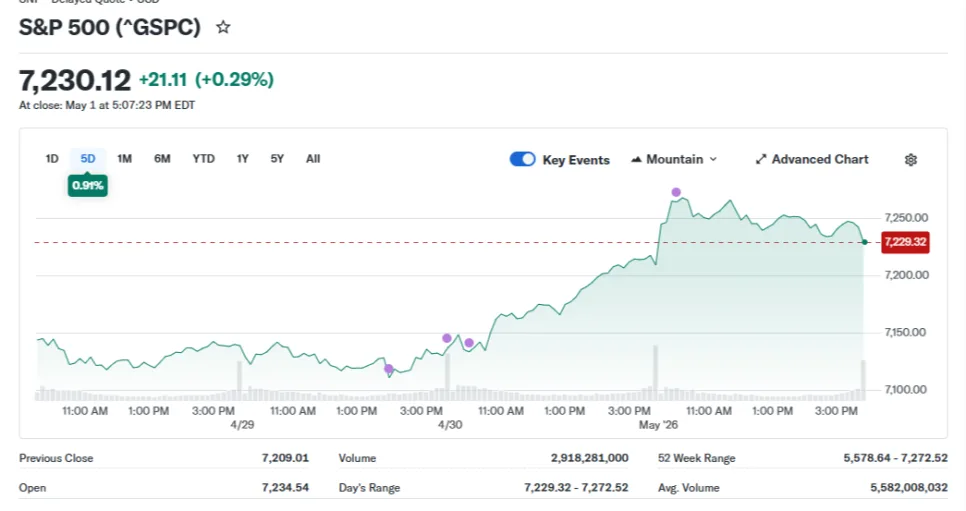
The US stock market in early May 2026 is expected to see moderate gains, driven by easing geopolitical tensions in the Middle East and a strong performance from semiconductor stocks. While previous weeks saw some volatility due to oil price fluctuations, the market closed with slight gains, largely thanks to the tech sector. Notably, Google saw a significant surge of nearly 12% following its cloud division's double growth and increased AI server investments. In contrast, Meta and Microsoft experienced declines amid concerns about return on investment, while Nvidia's performance was influenced by potential intensification in AI chip competition. Memory chip manufacturers like Micron and Sandisk continued their upward trend, buoyed by projections of increased AI investment from major tech firms. Visa and Caterpillar also contributed to market strength with robust earnings reports, climbing over 6% and 7% respectively. The demand for AI processing power also positively impacted Intel and AMD's stock prices.
South Korean Market (KOSPI, KOSDAQ) Outlook: First Week of May 2026?
Despite positive news from Samsung Electronics, the South Korean market faced headwinds in the first week of May 2026 due to high oil prices and a lengthy holiday period, leading to a market adjustment. However, a rebound is anticipated towards the end of the week. LS Electric, a key player in the power equipment sector, showed strength, alongside AI-related stocks including semiconductors and robotics. Nuclear energy and large-cap stocks like SK Hynix and Samsung Electronics also garnered attention. The KOSDAQ market saw active trading in AI semiconductor and robotics sectors, with some companies experiencing significant price increases. While the overall market experienced a slight downturn, the underlying trend for AI-related industries remains positive, indicating potential for recovery and growth.
Key Investment Themes for May 2026
In May 2026, investors should closely monitor several key themes. The power equipment sector, exemplified by LS Electric, is showing strong momentum, driven by increased infrastructure spending and grid modernization efforts. AI-related stocks, particularly in semiconductors and robotics, continue to be a major focus, with ongoing innovation and demand for AI-powered solutions. The nuclear energy sector is also gaining traction as countries look for stable, carbon-neutral energy sources. Furthermore, large-cap stocks such as SK Hynix and Samsung Electronics are considered stable investments, offering potential for steady growth. For those interested in the robotics and autonomous driving space (Physical AI), opportunities are emerging as these technologies mature and find wider applications. Investors should also consider the 2nd generation battery and automotive sectors, which may present buying opportunities during market dips.
Long-Term Investment Strategy: Focus on AI Beneficiaries
From a long-term perspective, sustained interest in AI beneficiary stocks is crucial. This includes the semiconductor, power equipment, nuclear energy, and Physical AI sectors (robotics, autonomous driving). Companies like SK Hynix and Samsung Electronics are recommended as relatively safe investments, suitable for a strategy of accumulating shares over a period of more than one year. While semiconductor component and materials ( 소부장) stocks offer higher return potential, their volatility necessitates thorough research before investment. The 2nd generation battery and automotive sectors can be approached with a strategy of phased buying during market corrections. Samsung Electro-Mechanics is currently hitting new highs, suggesting further upside potential for existing holders, supported by momentum in silicon capacitors and favorable market sentiment. Ultimately, investment strategies should align with individual risk tolerance and market conditions, making consultation with a financial advisor advisable.
For more details, check the original source below.





