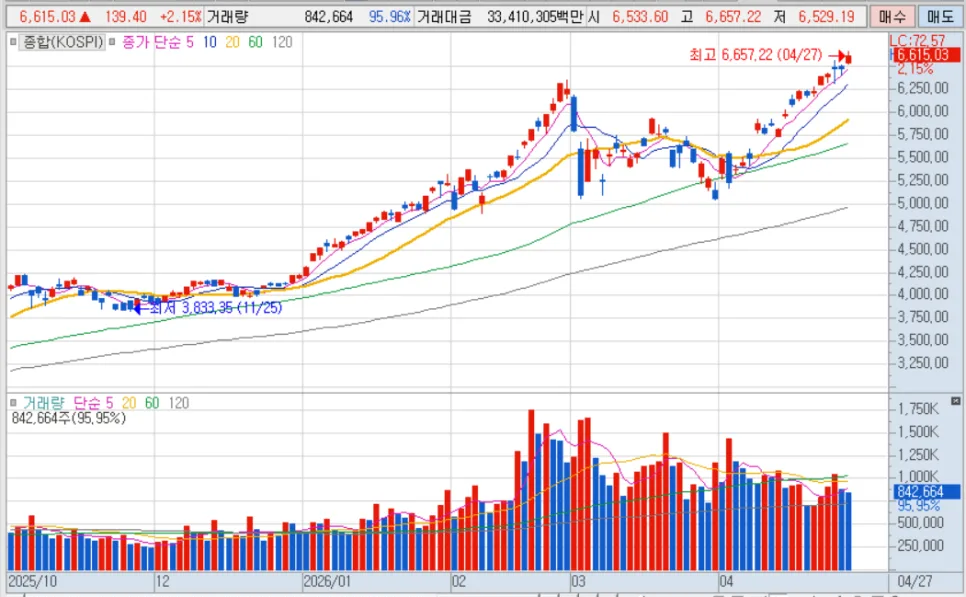
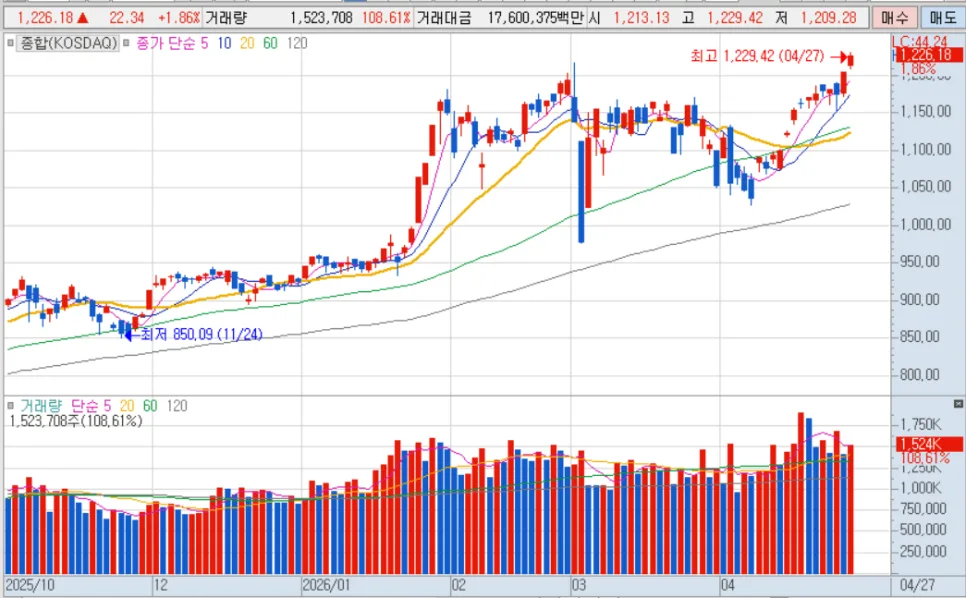
As of April 27, 2026, understanding the stock market's key movements is crucial for investors. This analysis breaks down the core trends in the KOSPI and KOSDAQ markets, providing essential insights for developing your investment strategy, including a detailed look at stocks hitting 52-week highs.
What Sectors Are Leading the 2026 Stock Market?
In April 2026, the South Korean stock market is showing strength in specific sectors. Beyond the overall KOSPI and KOSDAQ indices, ETFs like KODEX KOSDAQ150, KODEX Semiconductor, and KODEX AI Semiconductor Equipment are performing well. Additionally, eco-friendly energy-related ETFs such as RISE Battery Active, PLUS Solar & ESS, TIGER Fn Renewable Energy, and HANARO Nuclear Select ETF are continuing their positive momentum. This trend reflects the government's enhanced renewable energy policies and the global energy transition. Many investors are increasing their allocation to these sectors, with growing expectations for improved corporate earnings. However, sectors like defense, aerospace, securities, and banking are showing neutral or mixed performance, requiring a cautious approach. Investors should carefully assess these sector strengths and weaknesses to build a balanced portfolio.
Customer Deposits and Margin Debt: Gauging Market Sentiment
As of late April 2026, customer deposits stand at approximately $95 billion USD (125.7 trillion KRW), indicating ample liquidity available for market entry. Margin debt is at around $27 billion USD (35.4 trillion KRW), suggesting some investors are actively using leverage. These figures point to generally positive investor sentiment, but excessive margin use can heighten volatility risks. Historically, rapid increases in margin debt have amplified losses during market downturns. Therefore, investors should leverage the abundant liquidity cautiously. Top stocks by trading volume include Hanmi Semiconductor, LS Electric, and Samsung Electronics Preferred, highlighting concentrated interest in semiconductors, power equipment, and large-cap stocks.
Which Stocks Hit 52-Week Highs in 2026?
On April 27, 2026, the stocks reaching new 52-week highs were primarily concentrated in the semiconductor, nuclear/power, renewable energy, and secondary battery sectors. Notably, semiconductor companies like TEMC, Hanmi Semiconductor, and ALT were among those hitting highs, reaffirming the sector's growth potential. Nuclear and power-related firms such as Iljin Electric and Hyosung Heavy Industries also showed strength, aligning with government energy policy directions. Other companies like Dongkuk Steel and Hyundai Department Store, which reported strong earnings or have high profit expectations, also reached new highs, attracting investor attention. However, penny stocks and companies with low market capitalization carry significant risks of sharp price fluctuations, demanding extreme caution. When investing in 52-week high stocks, it's essential to consider the company's fundamentals and prevailing market trends comprehensively.
Investor Trading Trends: Reading Market Direction
Analyzing investor trading activity on April 27, 2026, reveals a pattern in the KOSPI market where individual investors sold while foreign and institutional investors bought. This suggests that institutional and foreign investors see higher market upside potential and are actively accumulating shares. Conversely, in the KOSDAQ market, individual investors were net buyers, while foreign and institutional investors were net sellers. This indicates individual investors are pushing the KOSDAQ's upward momentum, while foreign and institutional investors are either taking profits or maintaining a wait-and-see approach. These supply and demand dynamics can be crucial indicators for predicting short-term market direction. Stocks consistently bought by foreign and institutional investors often have higher long-term growth potential. Investors should use this data to inform their own investment strategies.
For more in-depth market analysis and investment strategies, consult the original source.